
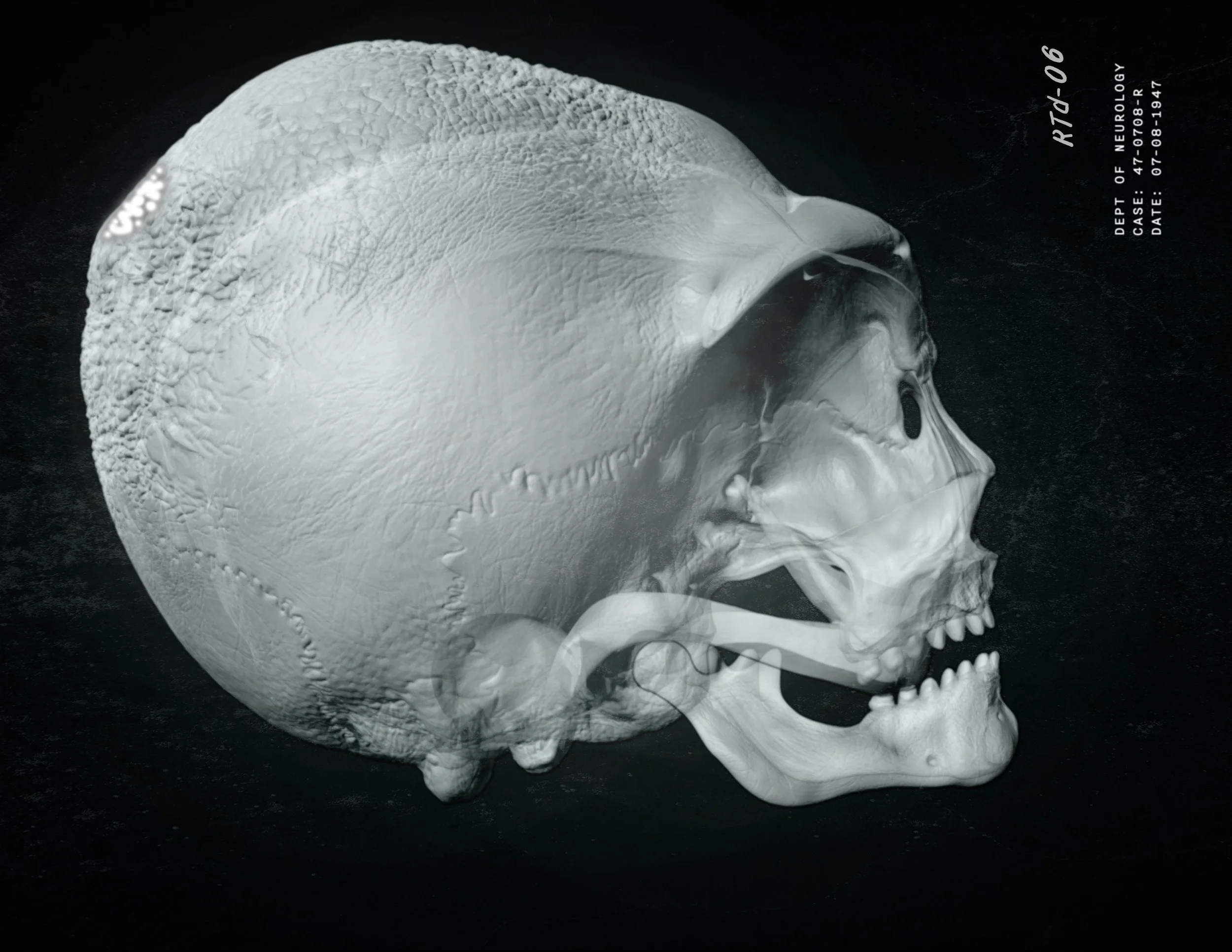
RTd-06. Dept. of Neurology. Case 47-0708-R. 07-08-1947.
The Roswell Transfer
“There’s something I can’t prove and can’t stop thinking about — how did six of them ended up in my warehouse?”
Before anybody started writing things down.
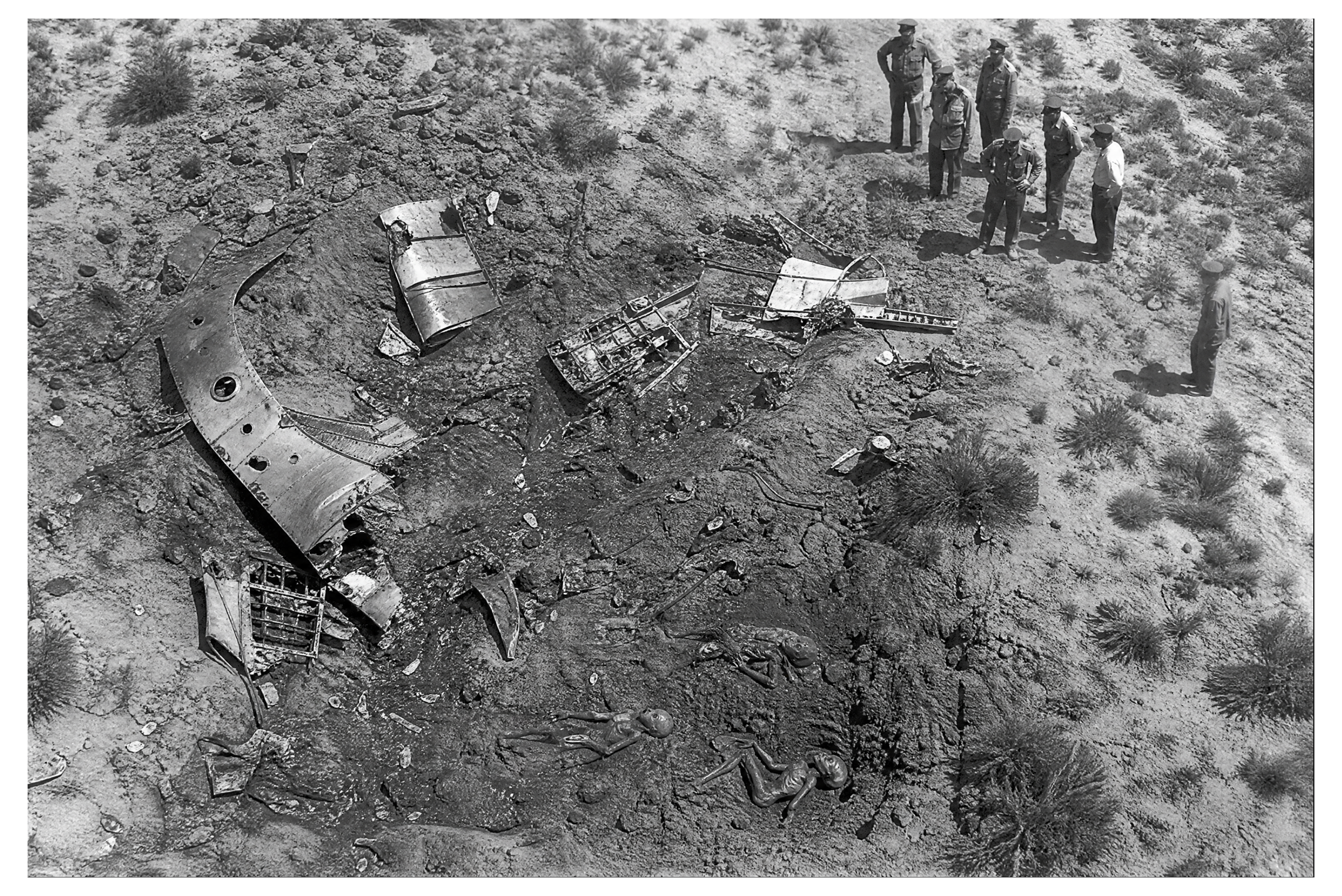
Impact site, looking northwest. Photographer unrecorded.
The first man on that ground got there at 8:47 in the morning on the eighth of July, and he looked at his watch when he arrived because you're supposed to.
Corporal Tate, MP, had been told there was a downed aircraft northwest, take a truck, radio back if it was something. Asked two days later whether that was really the extent of his briefing, he said:
> Yes sir. That's most of what they ever say.
He'd been on four crash details before. He knew what a crash looks like and he knew what one smells like — gasoline, burnt rubber, hot oil, half a mile out, every time. Nothing was burning. There was a furrow four or five hundred feet long cut down off the ridge where something had come in hard and slid, and at the bottom of the wash there was a thing on its side with no wings, no engines, no props, and not one rivet anywhere on it.
> I walked the whole length of it and I never found a seam or a weld or a number stamped on anything.
Asked about an odour, he said yes sir, and it was wrong. Sulphur, strong enough you tasted it, like a struck match that didn't quit. It was still on his uniform that night. And the ground was warm — Not from the sun, warm from underneath.
Everything on this page after this point is paperwork. This is the only part that isn't.
Material.
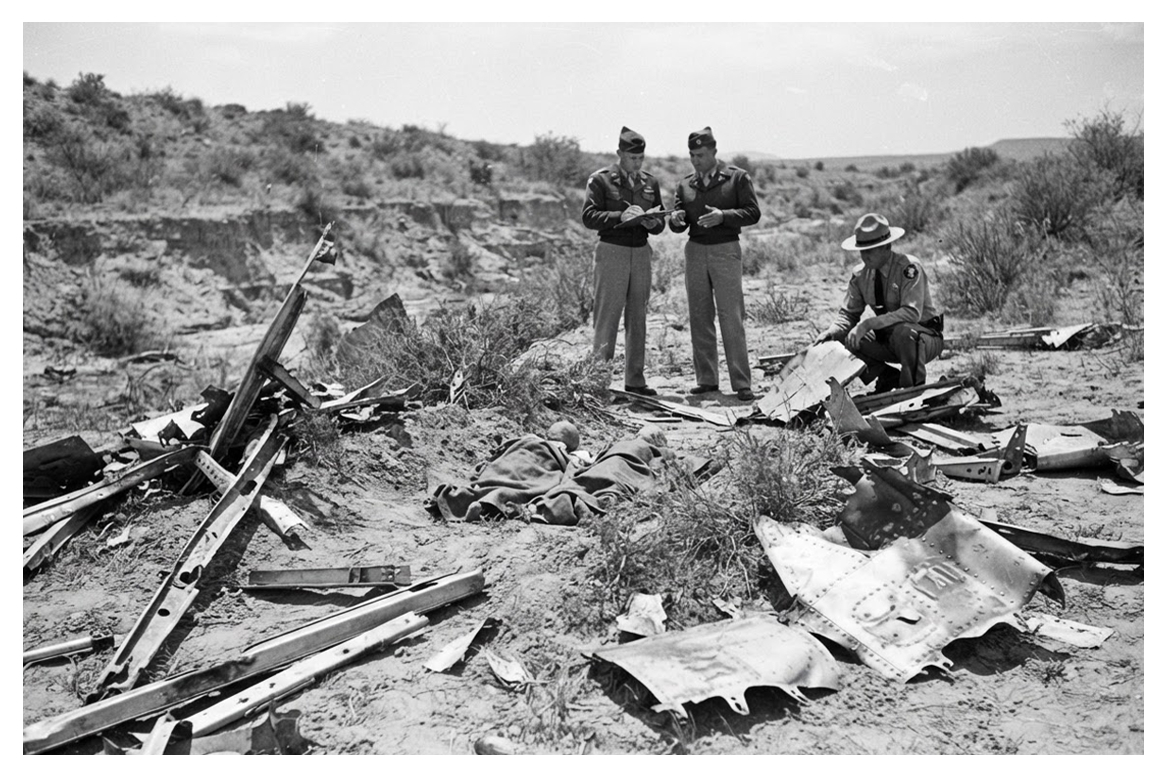
Recovery detail at the wash.
He counted six. He counted them twice, before anybody else got out there, because the debris was scattered enough that you could walk right past one.
Two days later, in a hard little room, he was asked what he found.
> TATE: Bodies, sir.
Some minutes on, the officer taking the interview began a question about where the recovered material had been situated. The corporal stopped him.
> TATE: Material, sir?
> INTERROGATOR: The recovered material.
> TATE: Oh. Yes sir.
The correction was offered the way you'd offer somebody a chair, and it was never mentioned again. He used the officer's word for the rest of the interview, and presumably for the rest of his life.
The teletype that went out to Ohio put it a third way:
> SIX BIOLOGICAL SPECIMENS RECOVERED STOP REPEAT SIX
Three words for the same thing inside forty-eight hours, and only one of them was ever going to survive into the file.
Sixteen Days.
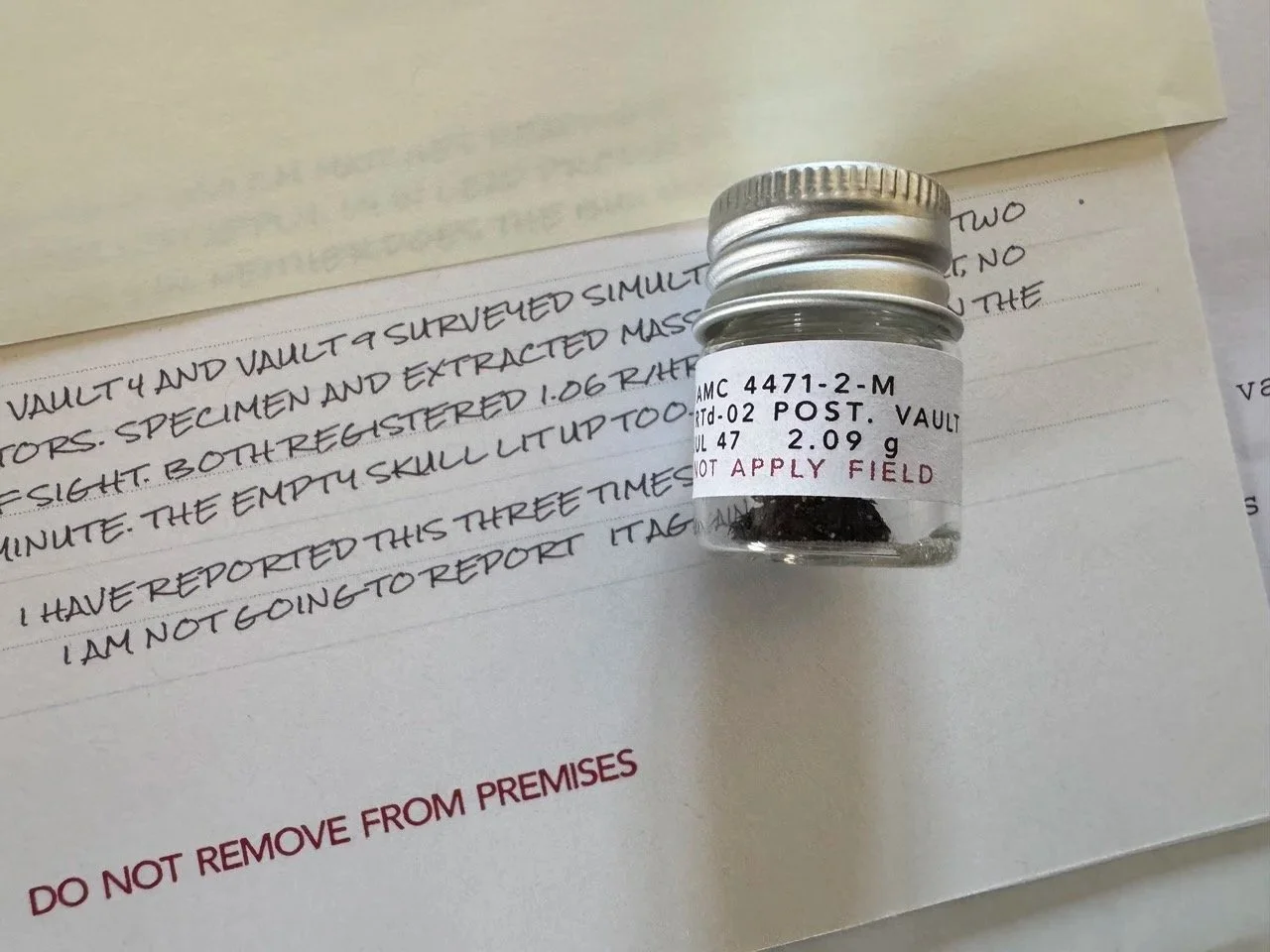
Specimen of ferrous material retrieved from the cranium.
On the tenth of July that corporal told an officer that all six of them were giving off light. In daylight, with the sun well up.
> INTERROGATOR: Sunlight on a light-colored surface will read as luminous at that hour.
> TATE: I know what the sun does.
He said he got down and cupped his own hand over one to make a shadow, and it was still lighting up underneath. Asked for a colour: green, sir. Cold green. Like a watch dial.
And then he said they were doing it together — coming up bright and going back down, all six, at the same time, in step, like something was keeping count.
> TATE: A reflection don't keep time, sir.
He was told, twice, that he had observed reflected illumination from vehicle headlamps, and yet there were no vehicles; his truck and the rancher's were both up above the arroyo, shut off and pointed the other way.
On the twenty-fifth of July the Radiological Safety Office logged a pulse at 0400 and it became a finding. Same phenomenon, same institution, sixteen days apart. The difference is that the second one was observed by a department and the first one was only observed by a corporal.
Nothing in the entire file noted this.
How a perfectly kept secret gets lost.
My theory starts where most of mine do, with a corrupt government — though not in the way that phrase usually goes. This isn't a story about a cover-up that worked too well. It's a story about one that worked exactly as designed and then simply outlived everybody who knew about it.
Whatever came out of that desert got buried under so many layers of clearance that almost nobody was ever told it existed. That protects a secret beautifully, right up until the program ends and the inventory passes to people who are cleared for property rather than for mysteries. The six weren't on any classified manifest. The handful who knew were dead or retired. The paper trail had been buried in its own secrecy.
So they weren't destroyed and they weren't guarded. They were forgotten about. The secret system aged quietly into the ordinary one, and the ordinary system did what it always does with unlabelled inventory and a deadline. It sold them at auction, in a lot beside the filing cabinets and the jeep parts.
A perfectly kept secret is a secret nobody can find.
Declined.
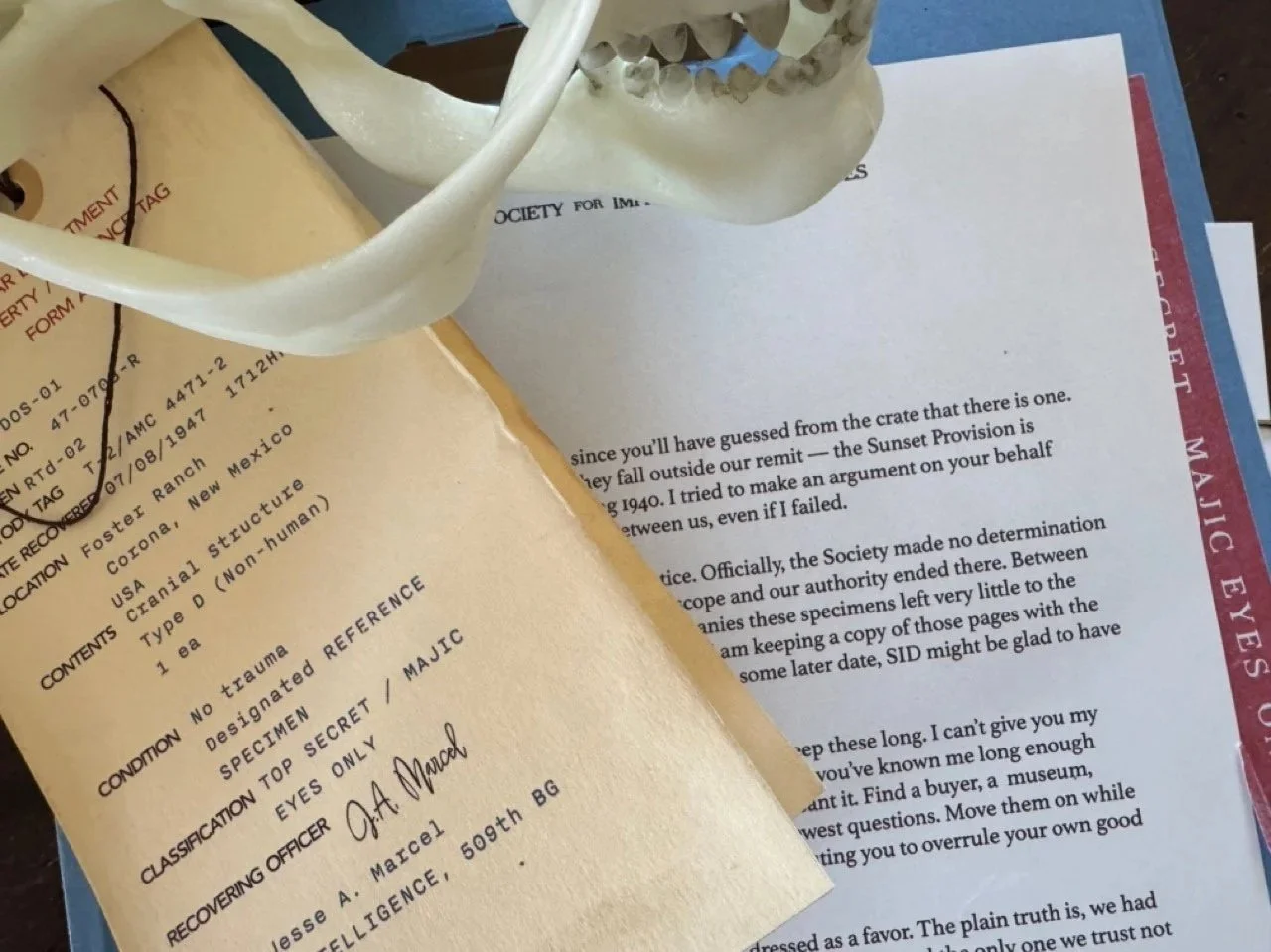
Transfer folder as received.
From there it goes about how you'd expect. Somebody bid. Somebody won. And somebody got their lot home, opened it, and worked out that what they had bought was considerably more responsibility than they had signed on for and not the kind of thing you move through an Army surplus store.
What they had bought was the exact species of improbable object that a certain Society exists to catalogue. So all six were donated, in good faith, to the Society for Improbable Discoveries — and the Society took one look at the provenance, found a date on the wrong side of the Sunset Provision, and declined. Out of scope. Their authority ended there.
They recorded a single line and walked away from the find of the century on a technicality.
I have gone back and forth for weeks on whether that is the most disciplined thing I have ever heard of or the funniest, and I want to be honest with you: I still cannot decide.
Which is how they came to me.
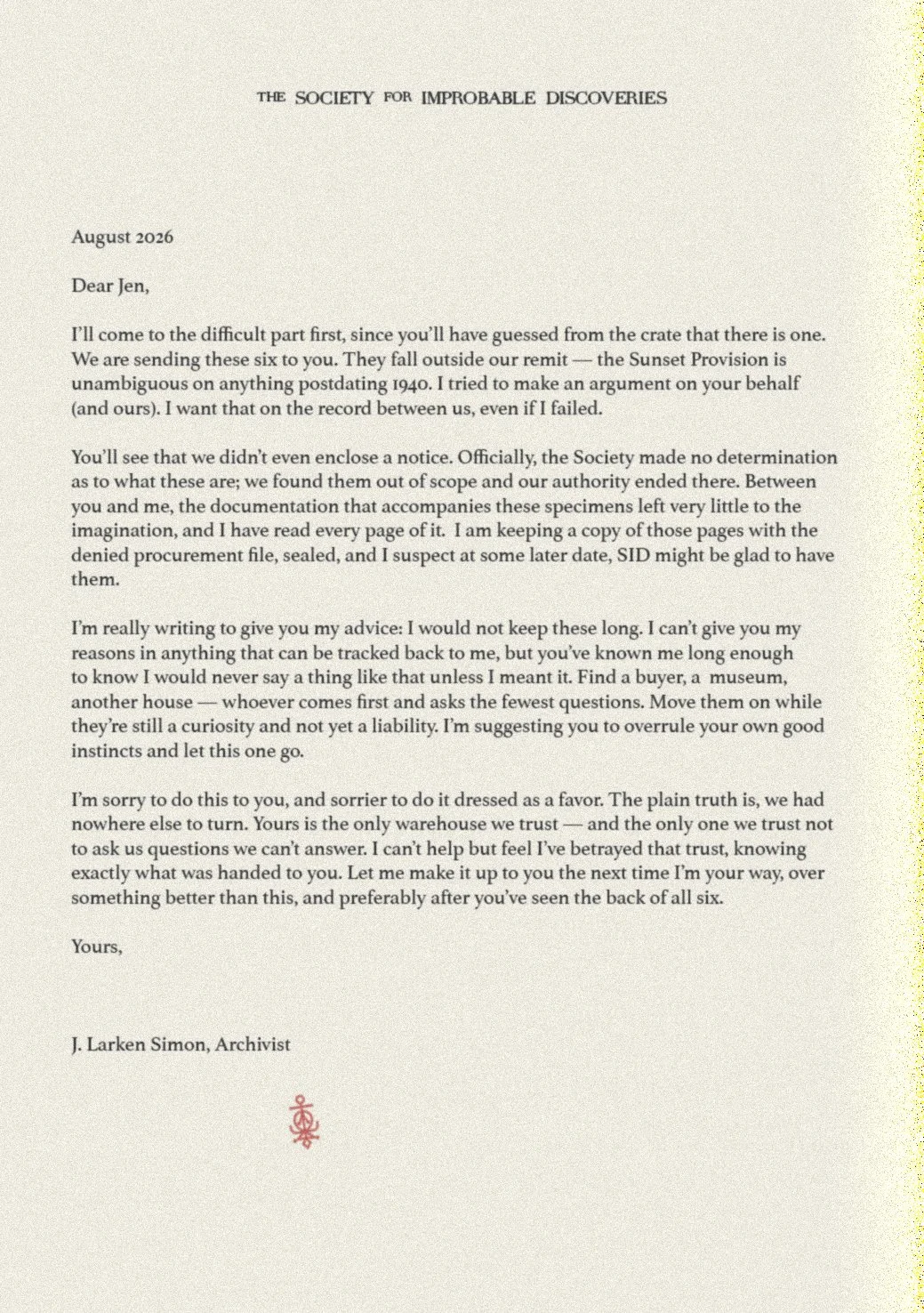
Correspondence accompanying the transfer. August 2026.
There was a letter in the crate, and I can’t help but feel that the most important line is I would not keep these long.
The acquaintance who wrote it has known me a long time and does not say things like that for effect. They couldn't give me their reasons in anything that could be traced back to them. They advised me to find a buyer — whoever comes first and asks the fewest questions — and to move them on while they are still a curiosity and not yet a liability.
So: six skulls that a very serious apparatus mislaid like a box of staplers, that an infinitely more qualified Society refused to so much as examine, now sitting in my inventory with every question they arrived with perfectly intact.
I can't tell you what they are, not definitively. Nobody who has held one could either, though I notice we all seem to arrive at the same guess.
What I can tell you is that they are lighter than they have any right to be. That they glow in the dark in a most marvellous way — cold green, which is a detail I did not know the significance of until I read the file. And that they are worth a great deal more for the questions they provoke than for any answer I could pretend to sell you.
Taboo and Company received six. We would like to have fewer, as soon as possible.