

Assessment of Crowther Drawings
Archives Department · Reassessment of the Crowther Drawings
TRANSCRIPT OF ORIGINAL REPORT
Filed 18 Nov 1892
Prepared by Dr. Beatrice Holloway, Assistant Keeper of Zoological Records
____
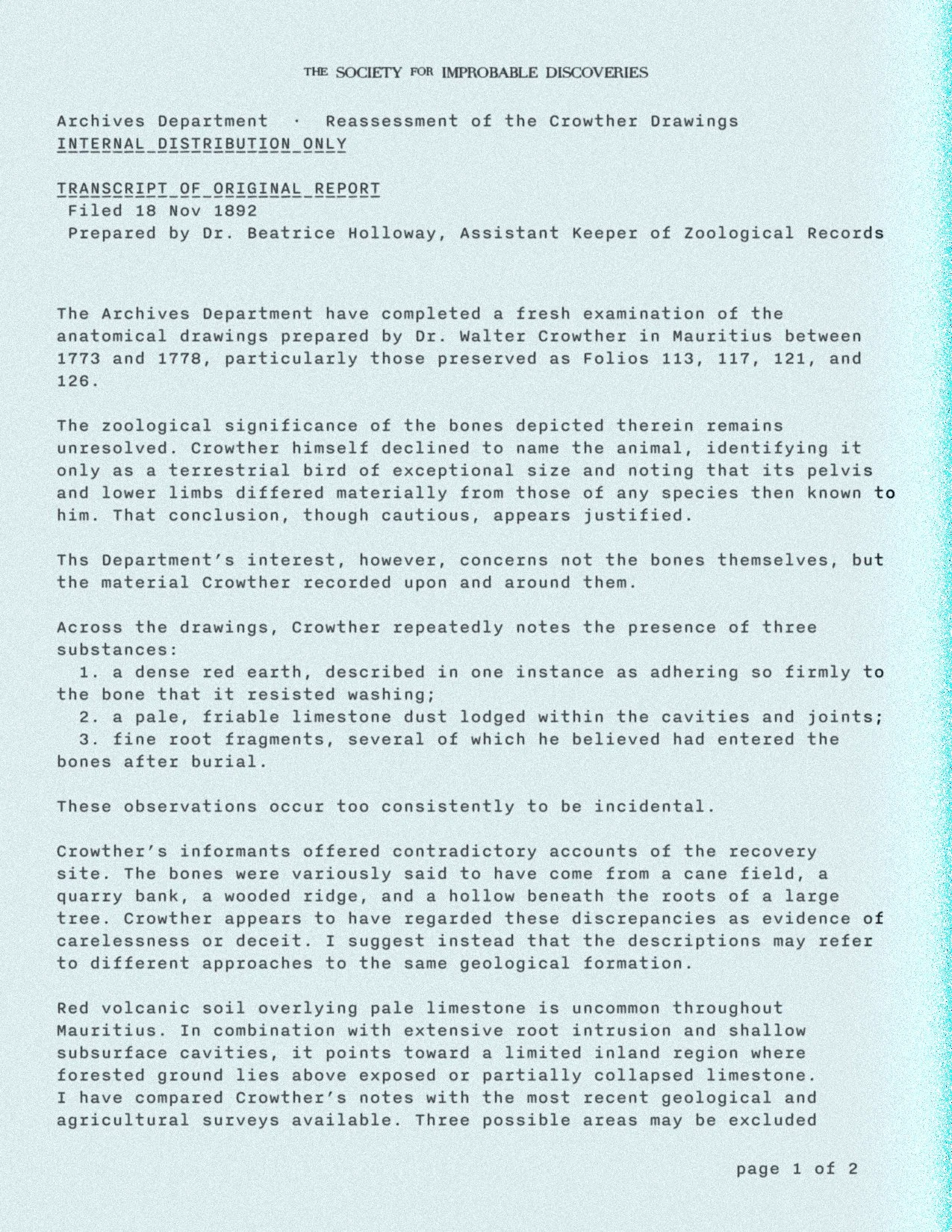
The Archives Department have completed a fresh examination of the anatomical drawings prepared by Dr. Walter Crowther in Mauritius between 1773 and 1778, particularly those preserved as Folios 113, 117, 121, and 126.
The zoological significance of the bones depicted therein remains unresolved. Crowther himself declined to name the animal, identifying it only as a terrestrial bird of exceptional size and noting that its pelvis and lower limbs differed materially from those of any species then known to him. That conclusion, though cautious, appears justified.
Ths Department’s interest, however, concerns not the bones themselves, but the material Crowther recorded upon and around them.
Across the drawings, Crowther repeatedly notes the presence of three substances:
1. a dense red earth, described in one instance as adhering so firmly to the bone that it resisted washing;
2. a pale, friable limestone dust lodged within the cavities and joints;
3. fine root fragments, several of which he believed had entered the bones after burial.
These observations occur too consistently to be incidental.
Crowther’s informants offered contradictory accounts of the recovery site. The bones were variously said to have come from a cane field, a quarry bank, a wooded ridge, and a hollow beneath the roots of a large tree. Crowther appears to have regarded these discrepancies as evidence of carelessness or deceit. I suggest instead that the descriptions may refer to different approaches to the same geological formation.
Red volcanic soil overlying pale limestone is uncommon throughout Mauritius. In combination with extensive root intrusion and shallow subsurface cavities, it points toward a limited inland region where forested ground lies above exposed or partially collapsed limestone.
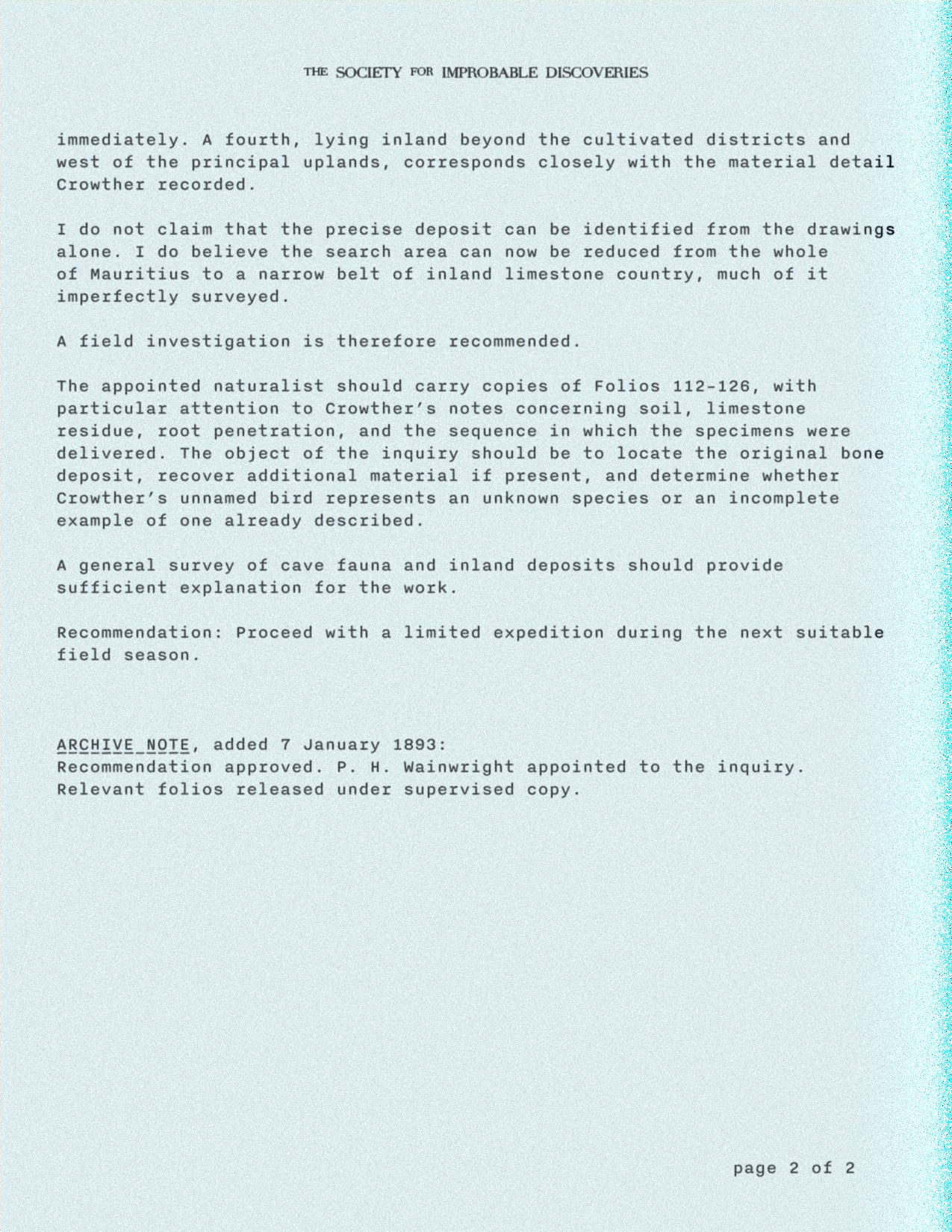
I have compared Crowther’s notes with the most recent geological and agricultural surveys available. Three possible areas may be excluded immediately. A fourth, lying inland beyond the cultivated districts and west of the principal uplands, corresponds closely with the material detail Crowther recorded.
I do not claim that the precise deposit can be identified from the drawings alone. I do believe the search area can now be reduced from the whole of Mauritius to a narrow belt of inland limestone country, much of it imperfectly surveyed.
A field investigation is therefore recommended.
The appointed naturalist should carry copies of Folios 112–126, with particular attention to Crowther’s notes concerning soil, limestone residue, root penetration, and the sequence in which the specimens were delivered. The object of the inquiry should be to locate the original bone deposit, recover additional material if present, and determine whether Crowther’s unnamed bird represents an unknown species or an incomplete example of one already described.
A general survey of cave fauna and inland deposits should provide sufficient explanation for the work.
Recommendation: Proceed with a limited expedition during the next suitable field season.
ARCHIVE NOTE, added 7 January 1893:
Recommendation approved. P. H. Wainwright appointed to the inquiry. Relevant folios released under supervised copy.